Most condolence flowers arrive on the same day, in the same week, addressed to the same house, and the family has nowhere to put them. Then three weeks later, when the phone has stopped ringing and the casseroles have stopped arriving, nothing comes at all.
This guide is about sending condolences flowers that actually help – what to send, where, when, and what to write. Some of it runs against convention, and it is worth reading before you order.
Home, Not the Service
The first decision is where the flowers go, and it matters more than what they are.
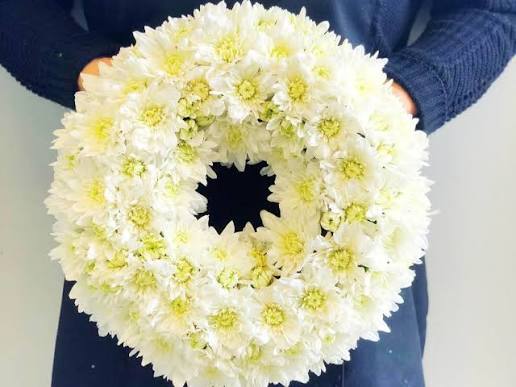
Funeral tributes – wreaths, casket sprays, sheafs – go to the funeral home or chapel and are part of the service. They are formal, they are seen once, and they are usually gone by the afternoon.
Condolences Flowers Sydney go to the home. They are for the family, in their kitchen, in the weeks afterwards. They are a different gesture with a different purpose.
If you are close to the family, condolence flowers to the home are almost always the more useful of the two. If you are more distant, or sending on behalf of a workplace or club, a tribute at the service is the appropriate form.
You can do both. But if you are choosing one, choose the home.
Send a Vase Arrangement, Not a Bouquet
This is the single most practical piece of advice on the subject.
A family in the first week after a death does not have the capacity to find a vase, trim stems, fill water and arrange flowers. They are dealing with paperwork, phone calls, relatives in the spare room, and grief. A wrapped bouquet is a small additional task.
A vase arrangement arrives ready to place. It requires nothing. It can be set on the kitchen bench and looked at.
Ask for it to be low, wide and stable rather than tall – easier to place, easier to move, and it does not tip. And ask for something that lasts: natives, chrysanthemum in antique tones, lisianthus, alstroemeria and carnation will hold two weeks or more. A fortnight of flowers helps considerably more than three days of something spectacular.
The Timing Nobody Uses
Here is the idea worth taking away.
Send flowers three or four weeks after the funeral.
The first week is saturated. Everyone sends everything at once – flowers, food, cards, phone calls. Then it stops abruptly, and that is precisely when the house gets quiet and grief settles in properly.
Flowers arriving in week four say I have not forgotten, and I know this is still happening. They land harder than anything sent in week one, because by then almost nobody is still sending anything.
Better still: send in week one and again in week four. Or set up a fortnightly standing order for two or three months. It is the same money spread out, and it means someone is checking in by proxy at intervals. For a recently widowed person living alone, this is the most useful thing a florist can do.
Anniversaries matter too – the person’s birthday, the wedding anniversary, and the first anniversary of the death. Flowers on those dates say something no card manages.
What to Choose
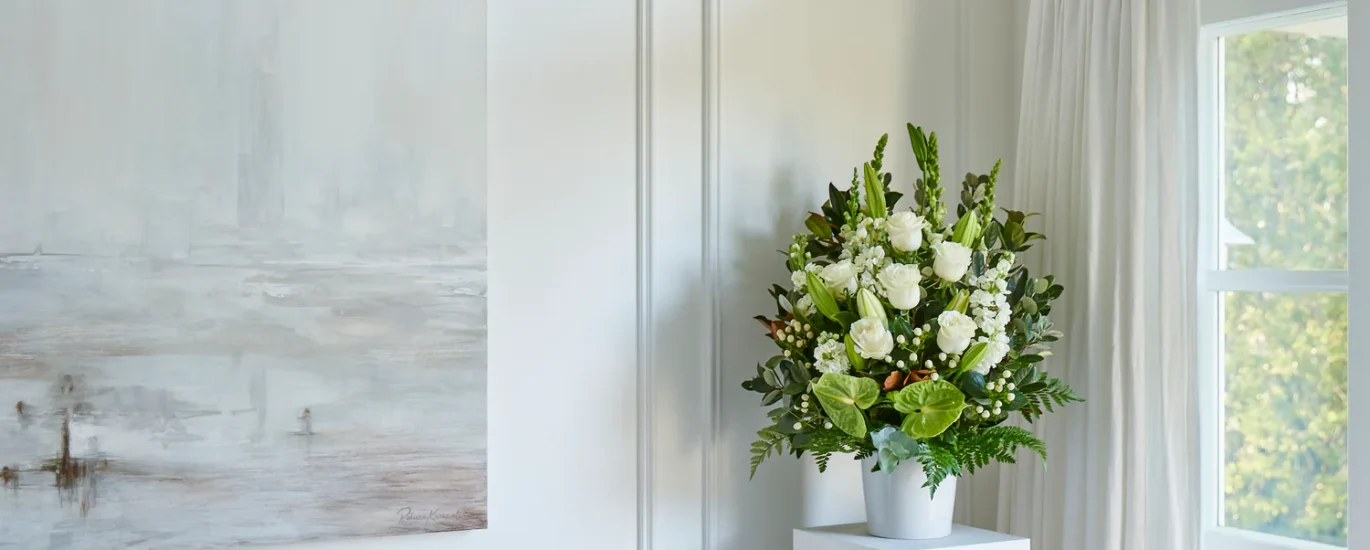
White and cream is the traditional and always-safe choice. White lisianthus, white rose, cream chrysanthemum, white stock, with dark green foliage. Calm, dignified, appropriate in any context.
Soft colour is entirely appropriate too, and increasingly common. Blush, dusty pink, soft apricot, pale yellow. Nobody finds gentle colour disrespectful, and it is often warmer in a kitchen than austere white.
The colours the person loved. If you knew them well enough to know, use it. It is more personal than any card.
Australian natives are a strong option, particularly for someone with a connection to the bush, the coast or the garden. Banksia, protea, waratah, gum foliage and flannel flower last for weeks, need almost no attention, and do not require the family to change the water every second day. For a household with no capacity for maintenance, this is genuinely the kind choice.
A plant instead. An orchid, a peace lily, a potted gardenia, or a native in a good vessel. It lasts for years and becomes something the family keeps rather than something they throw out.
Avoid: overpowering fragrance in a small home (heavy oriental lily can be too much in a hot week), anything requiring immediate arranging, and anything so large it becomes a logistical problem.
Ask for lily anthers to be removed if lilies are included. The pollen permanently stains fabric.
What to Write
Short. Specific. Signed with your full name.
The family will read many cards and will not remember most of them. The ones they remember contain something concrete about the person.
Lines that work:
- With our deepest sympathy. Thinking of you all.
- I am so sorry. She was extraordinarily kind to me and I will not forget it.
- No words. Thinking of you and here whenever you need anything.
- He talked about you constantly and with enormous pride. I am so sorry.
- With love and sympathy. I will always remember his laugh.
- Thinking of you today and in the weeks to come.
What to avoid:
- “Let me know if you need anything.” Well-meant and useless. Offer something specific instead: I will drop dinner over on Thursday unless you tell me not to.
- Anything that requires a reply. They are not up to replying.
- Religious language unless you know it will be welcome.
- “At least…” in any form. “At least she is not in pain.” “At least he had a good innings.” These do not help.
- Unsigned cards. The most common mistake in floristry, and worse here than anywhere else.
Cultural Considerations
Sydney is diverse and customs vary considerably. When in doubt, ask the funeral director or a mutual friend.
- Jewish – flowers are generally not customary. Food sent to the family during shiva, or a charitable donation, is the appropriate gesture.
- Islamic – flowers are usually not part of the tradition, and simplicity is valued. Food and practical help are welcome.
- Chinese and many Asian communities – white and yellow are appropriate; red is avoided. White chrysanthemum is traditional.
- Hindu – flowers, especially garlands, are traditional. White and yellow are common.
- Buddhist – white and yellow appropriate, red generally avoided.
- Orthodox and Catholic – flowers welcome and expected.
If the death notice says “in lieu of flowers, donations to…”, respect it and send a card instead.
Practical Notes on the Order
- Include a mobile number for the recipient. Grieving households do not always answer the door.
- Give precise access details – unit number, side gate, dog, whether there is a safe place to leave it.
- Ask for delivery in the morning where possible; afternoons in a grieving house are often when people finally sleep.
- If the family has gone away, hold the delivery. Flowers dying on a doorstep is worse than nothing.
- Write the card message in full and sign with your first and last name. The family may not place a first name alone.
Coverage and Cut-Offs
From a lower North Shore workroom, realistic same-day cut-offs:
Around 1pm: North Sydney, Cremorne, Cremorne Point, Neutral Bay, Kurraba Point, Mosman, Cammeray, Crows Nest, Waverton, Wollstonecraft, McMahons Point, Lavender Bay, Milsons Point, Kirribilli.
11am to midday: Chatswood, Willoughby, Northbridge, Artarmon, Naremburn, St Leonards, Lane Cove, Greenwich, Riverview, Longueville, Linley Point, Roseville, Manly, Seaforth.
10am to 11am: Hunters Hill, Woolwich, Huntleys Cove, Huntleys Point, Gladesville, West Pymble, Clontarf, Balgowlah Heights, Allambie Heights.
If the Family Is Also Planning the Service
It is worth knowing that support exists beyond flowers. Cemeteries and Crematoria NSW publishes practical guidance for families on planning for burial, cremation and ways to commemorate life, including checklists that many families find genuinely steadying in the first fortnight.
And if you are wondering whether flowers actually do anything: there is reasonable evidence that they do. Research from the University of Queensland on flowers, plants and psychological wellbeing describes consistent effects on mood from bringing fresh seasonal flowers into a space. It will not fix grief. It does put something living on the kitchen bench in a week when very little feels alive.
Care Notes for the Recipients
- Change the water completely every second day rather than topping it up.
- Recut stems 2cm at 45 degrees when the water is changed.
- Use the flower food sachet.
- Remove any spent stem promptly – one dying flower accelerates the rest.
- Keep it away from the fruit bowl and out of the afternoon western sun.
- Native stems need the least attention and hold a week between water changes.
The Bottom Line
Send condolences flowers to the home rather than the service, as a low stable vase arrangement rather than a wrapped bouquet, made of things that last a fortnight. Then send again in week four, when everyone else has stopped. Write one specific sentence about the person, sign it with your full name, and offer something concrete rather than “let me know if you need anything.” That combination is worth more than the most expensive tribute at the chapel.